Hi friends! While surfing the Huffington Post I came across this article that is absolutely worth reading. It addresses many things that we, especially in America, don’t value but should. We are so busy being ruthlessly busy, stressed, overworked and under appreciated that we often forget to take pause. Or even enjoy the activities we are so busy doing. My point is this: We have forgotten how to be in the moment. We’re always planning/thinking/living months, even years ahead and it’s getting us nowhere. Take a quick read. Happy living!
Secrets From The Island Where People Forget to Die
By Laine Bergeson
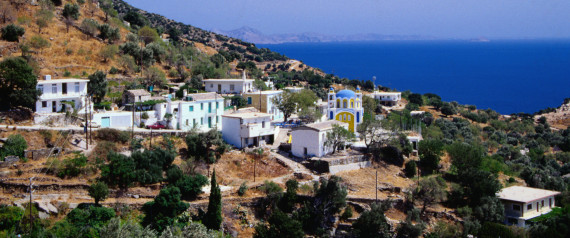
On the Greek island of Ikaria, people forget to die.
For the most part, they also forget to get sick — the island’s many nonagenarians experience relatively little cancer, cardiovascular disease or dementia.
This small island in the north Aegean Sea has been the subject of much study by researchers across the world. Every outsider wonders: What is the secret to a long and healthy life?
In her new cookbook Ikaria: Lessons on Food, Life, and Longevity from the Greek Island Where People Forget to Die, ancestral Ikarian and part-time resident of the island, Diane Kochilas, offers an insider’s perspective on why this far-flung Greek community lives so long and so well.
An award-winning author of more than 18 books on Greek cuisine, Kochilas offered Next Avenue her six top longevity secrets from this remote corner of the world, as well as a recipe from her book — Spicy Black-Eyed Peas and Greens with Smoked Herring — that is unique to the island.
From her home in Greece, Kochilas emailed us these six secrets to a long life:
1. Eat locally, seasonally and sparingly. The octagenarians, nonagenarians and centenarians I spoke with on Ikaria all described the eating habits of their early years — years of dire poverty, dearth and isolation — not so much in terms of what they ate but of how little they ate, because there simply wasn’t that much food.
Meat was rare, for some as rare as two to three times a year on the big holidays. For others who may have had animals (mainly chickens), they could afford to slaughter a few times a month. Fish was accessible if one fished; gardens were carved into terraces along Ikaria’s steep slopes and watered sparingly.
The 100-year-olds ate what they found in nature, from snails to mushrooms to wild greens, as well as what their gardens provided. There was and is still virtually no processed food on the island, except in some restaurants.
2. Live deliberately and don’t rush. The pace with which people move on Ikaria (including my own family!) never ceases to amaze me: slow, deliberate, unhurried, but with enough time to observe and live in every moment.
It’s the pace that means when you go to buy a jar of honey from our friend and beekeeper, Yiorgos, for example, you sit down across from his desk first, gab a bit, joke a bit, flirt a bit, then about 20 minutes into the exchange he gets up and lumbers over to his honey cans. He’s 84. And when he says there is no need to rush, you listen.
It’s the pace that enables people to feel their bodies from the inside, as one does in meditation exercises, and to know if something might be ailing. I had an older aunt who could feel her body in that way and when I started to meditate, I understood her in a different light. It takes tremendous presence and a sense of the now to be able to achieve that kind of sensitivity.
The penchant for taking things slowly has to do with Ikarians’ sense of time, or lack thereof. Resistance, or rather dismissal of the clock as ruler of life, is legendary. If you are not from here it’s hard to explain that mentality, the mentality of “it’s OK to be late, or “it’s OK to leave some wiggle room and maybe not show up at all.” I understand it instinctively. Sometimes it’s very frustrating, but I think the deeper sense of not living by the clock is living by the creed that “man plans, God laughs.”
3. Enjoy sleep. We sleep so much when we are on Ikaria. It’s a godsend. I don’t know if it’s the atmosphere or the clean air, but I can sleep there totally soundly for 10 hours, even with daylight pouring into the room. Ikarians nap. All older Greeks nap.
Sleeping in the afternoon enables you to have two lives in one day, especially in the summer, which is when I experience Ikaria most: the one that starts in the morning, around 9 a.m., and goes through about 7 p.m., and then starts up again at around 11 p.m. and goes through, well, whenever. Usually around 3 a.m. for us old folks!
4. Let things go. The Greeks say, “Don’t hold the bad in.” There is so much truth and wisdom in that. Ikaria is a place where people tend to be easygoing, forgiving and unstressed. It’s also a place where the local culture allows for a very liberal interpretation of what it means to be uninhibited. The panygyria, local feasts of wine and dancing that are usually in celebration of a saint’s name day, are the place to witness how we let loose and enjoy it. Dancing has a lot to do with it. So does the strength of the local wine.
5. Turn to herbs for most of the minor things that ail you and let your body heal itself. The folk pharmacopoeia is vast on the island, and I’ve only touched the tip of the iceberg in the book.
6. Walk. Plain and simple. Exercise for priming body and mind alike. Every old person I know on Ikaria still walks a lot.


 The Dancing Diaries